The patent circuit: from application to enforcement.
On the surface, a patent is a fairly simple concept. It protects an invention. However, just as designing, engineering and manufacturing a product is a complex process fraught with potential risks, a patent is much more than simply protection for an invention.
The concept behind the US patent system goes all the way back to the original US Constitution ratified in 1787. Even before there was a Bill of Rights and such American concepts as freedom of speech and due process, Congress had the power to “promote the progress of science and useful arts, by securing for limited times to authors and inventors the exclusive right to their respective writings and discoveries.” From that Constitutional authority, the US patent system was founded. A patent is a time-limited monopoly granted by the federal government to inventors. A patent encourages innovation by giving a patent owner exclusive rights to his or her invention.
A US patent always names an inventor or inventors. If the patent was developed by inventors working for a business or researchers working for a university or other institution, the patent is often assigned to the inventors’ employer. In such cases, a patent has both an inventor or inventors and an assignee.
A patent is an exclusionary right. It is the right to exclude others from using the patented invention without permission of the inventor or assignee. Title 35 of the United States Code (or “35 USC”) is the federal law that covers patents. Section 271 of 35 USC defines patent infringement as when a person or other entity “makes, uses, offers to sell, sells or imports” a product or service that uses the patented invention without the patent owner’s permission.
There are three types of patents: The most common is the Utility Patent that covers a product, device, process or composition of matter. There is also a Design Patent that covers the appearance of a product and not how the product operates, and there are Plant Patents that cover asexually reproduced vegetables, fruits, trees and other botanical species. The term of a Utility Patent is 20 years from the date of application.
The US Patent and Trademark Office (or USPTO or simply “Patent Office”) currently issues about 180,000 patents a year, about half to US residents. The USPTO is an agency of the US Department of Commerce and is headquartered in Alexandria, Virginia. The Patent Office is just one of a few self-funded federal agencies. The USPTO uses no tax dollars, but is funded entirely from the money it collects from application and maintenance fees.
What a patent is not. There is a common misconception about patents. Since patent infringement occurs if a patented invention is used without permission from the patent owner, many people assume that you therefore need a patent to “make, use, offer to sell, sell or import” a product that uses your own invention. Not true. A patent is not the right to use your own patented invention; it is only the right to exclude others from using your patented invention!
You only need permission to make, use, offer to sell, sell or import a product that uses someone else’s patented invention. In that case, your options are to buy the patent (patents are assets that can be bought and sold like inventory, real estate and securities), license the patent (have the patent owner agree to let you use the patent in exchange for a fee, usually a royalty based on unit or dollar sales of the product that uses the patent, or infringe the patent and risk a patent infringement lawsuit by the patent owner.
So, if no patent is required to practice your own invention, should you patent your latest technology?
To patent or not to patent. That is, indeed, the question! While a patent gives you the right to exclude others from making, using, offering to sell, selling or importing a product that embodies your patented invention, that exclusionary right comes with a condition: You must publish your invention.
All patents are public documents. Before the Internet, the Patent Office operated patent libraries – the agency still does – in federal office buildings across the country, where anyone could view a patent. Today, of course, all US patents are available online. So a patent is essentially a bargain with the federal government. In exchange for the right to exclude others from making, using, offering to sell, selling or importing a product that uses your patented invention, you must disclose your invention to the public.
The reasoning behind this is that each invention in turn leads to the next invention. Public disclosure of inventions prevents another inventor from having to reinvent what has already been invented, but instead jump to that point in the technology and work forward from there. Among patent practitioners, patents are generally classified as a “fundamental” patent – one that represents a breakthrough technology like the telephone, airplane or transistor – and an “improvement” patent that takes an existing concept to the next level. And it looks like the system works, since the US continues to be the global leader in innovation, in no small measure a result of the US patent system.
Why not patent an invention? Under what circumstances might an inventor or business decide not to patent its latest new technology? The alternative to patenting an invention is to keep the technology under wraps as what is called a “trade secret.”
Like everything else in business, technology and law, there are benefits and drawbacks to patenting your invention or keeping it as a trade secret. While you lose the protection afforded by a patent, you gain the advantage that you do not have to publish your invention if you decide to keep it as a trade secret. If you do not file for a patent, you can simply keep your invention as your own secret, proprietary technology. However, the process of keeping a trade secret “secret” is by no means simple.
As long as none of your competitors reinvents or reverse-engineers your new technology, you can keep and practice your trade secret for years … maybe forever. The Coca-Cola Co. made the critical decision over 100 years ago not to patent the formula for its soft drink. Had the company patented the formula, once the patent expired, any competitor would have been free to duplicate it and produce an identical beverage.
However, going the trade secret route runs the risk that a competitor either reinvents your invention or reverse-engineers it. At that point, your competitor is free to make, use, offer to sell or sell products or services that use your invention because there is no patent on it, and there is nothing you can do about it. As a result, if you decide to keep your newest mousetrap a trade secret, you need to put into effect safeguards that will, in fact, keep it secret. The new technology can only be revealed to a small, select group of employees on a strictly need-to-know basis, and all documentation must be kept under lock and key. The Coca-Cola formula is reputedly kept in a vault in an Atlanta bank and is known only to a key group of senior, trusted employees. In fact, Coca Cola legend has it that the company purposely buys ingredients that do not go into the soft drink just to throw off their competitors as to what is actually in the formula!
What should be patented, and what should not? While every new technology has to be considered on a case-by-case basis, a general rule to start with is that most products should be patented, while a process may be a candidate for trade secret. The logic is that a product can be purchased by a competitor who can disassemble, study and examine it, then reverse-engineer it to duplicate what you did to produce a very similar or identical product.
A process, however, that is not seen by the public and that does not leave a fingerprint is a candidate for trade secret. If what you do in your plant, laboratory or other facility to produce a product or service is not seen by the public, and it would be very difficult (or, better yet, impossible) for a competitor to reverse-process your secret process, it may be the better option to keep your process as a trade secret. What the ingredients are in the Coca-Cola formula, how they are blended, and under what circumstances must be very difficult to reverse-engineer based on the fact that no one has been able to do it over the last 100 years.
The other factor that cuts across all of this is the life expectancy of the new product. Your patent will only give you protection for 20 years from the date of filing of your patent application. If the life of the product that uses your patented invention is likely to be less than 20 years – as it is today with many high-tech products – that means that by the time your patent expires and competitors are free to copy it, it will be obsolete anyway. We do not know if John Pemberton, the inventor of Coco-Cola, knew that his drink would capture the hearts, minds and taste buds of America and would endure for over 100 years, but he obviously made the right decision to not patent the formula. Had Pemberton filed for a patent when he developed the Coca-Cola formula in 1886, the patent would have expired over 100 years ago!
In short, if it is likely that a competitor could re-invent or reverse-engineer your invention, you are better off patenting it. If it is unlikely that a competitor could re-invent or reverse-engineer it, you might consider keeping it a trade secret. And that is a tough call to make!
Receiving a patent. The requirements for an invention to receive a patent are that it be novel (that is, new, and something that has not been done before), non-obvious (it is not something that another person could have easily figured out or come up with on his or her own) and useful (it must have a practical application).
Most inventors engage a patent attorney to assist with the patent application process. It currently takes about three years to receive a patent, and the entire process will run several thousand dollars in Patent Office and patent attorney fees.
Fighting infringement. Let’s say you file for and receive a patent, and you come across a product or service that appears to infringe your patent. First, it is entirely possible that the product or service does exactly what your patented product or service does, but does so in a different manner, and so does not infringe your patent. For example, a gasoline engine looks like and performs the same function as a diesel engine, but the technologies are totally dissimilar.
In order for a product or service to infringe your patent, it must duplicate all the elements in at least one claim in your patent. The term patent professionals use is that the product or service must “read on” at least one claim in the patent.
Should you believe that a product or service is infringing your patent, the remedy available is to file a patent infringement lawsuit in US District Court. If your case goes to trial and you win, the court will award “reasonable royalties”: what it believes the infringer would have paid in royalties had the infringer licensed your patent in the first place.
However, like most civil litigation, most patent infringement lawsuits do not go to trial but are settled out of court. Should the infringer agree to a settlement, the amount will likely be computed along the same lines – what would the royalty have been had the infringer licensed the patent? Your settlement will likely also include a license with the infringer to cover future use of your patent (if the patent has not expired).
Compensation of reasonable royalties for the infringement of a patent is predicated on the basis that the infringement was unintentional. That is, the infringer accidentally reinvented your patented invention, and did not know it was infringing your patent. However, should you be able to prove willful infringement – the infringer was aware of your patent but went ahead and decided to make, use, offer to sell, sell or import a product that used your patented invention anyway – the court may punish the infringer by awarding additional damages. The court could award as high as triple (or “treble” in legalspeak) damages. However, proving willful infringement is very difficult, and if the defendant settles out-of-court, it is highly unlikely that it will admit to willful infringement.
A select group of patent owners that meets very specific requirements may be able to receive “injunctive relief,” an injunction from the court ordering the infringer to cease making, using, offering to sell, selling or importing the infringing product. There are a few exceptions, but injunctive relief is not available to most patent owners that do not practice their patents. Such a patent owner is known as an NPE (“non-practicing entity”). However, in limited circumstances, a patent owner that practices its patent (a “market participant”) may be granted injunctive relief, if it also meets other critieria.
The question the patent owner facing infringement must ask is: Do I want justice, or do I want compensation? If your patent is being infringed by a direct competitor that is stealing sales and profits that rightfully belong to your company, then it may be justice in the form of a court injunction. However, if the infringer is a much larger company, or it operates in a different industry, and you can prove infringement and reach a settlement with the infringer, compensation for the use of your patent could turn out to be a very nice revenue stream!
Since patent infringement is not a crime, there are no “patent police.” It is the job of the patent owner to enforce their or its patent. Filing a patent infringement lawsuit can be very expensive, running from a few hundred thousand dollars to several million dollars. It only makes sense to pursue an infringer that is generating millions of dollars a year in sales from the product that infringes your patent, or there will not be a large enough return – from an award from a trial or from an out-of-court settlement – to cover litigation expenses.
For the patent owner that does not have the capital to spend on a lawsuit, there are a few law firms that will work on a contingency basis, taking part or most of their fees from any awards or settlements they secure on behalf of the patent owner. There are also patent enforcement firms that specialize in managing and financing patent enforcement campaigns on behalf of patent owners on a 100% contingency basis. Under the patent enforcement firm business model, the patent owner pays nothing, and the patent enforcement firm bears all costs, manages the entire patent enforcement campaign, engages and supervises a law firm to try the lawsuit, and offers several additional services.
Most businesses do a pretty good job of protecting their traditional assets – inventory, equipment, real estate and cash – but these are all assets that can be easily replaced. In today’s intensely competitive flat world, a company’s intellectual assets are far more valuable – and far more difficult to replace – than its balance sheet assets. Every business needs to have a plan to protect its innovations, technologies and know-how, either by patenting it or securing it as a trade secret.
Kathlene Ingham is director of licensing at General Patent Corp. (generalpatent.com); This email address is being protected from spambots. You need JavaScript enabled to view it..
BOSTON As an IPC task group ramps work on the latest revision of IPC-2581, the PCB manufacturing data transfer format, Mentor Graphics is continuing work on its own format, ODB++.
PCD&F spoke this week with Julian Coates, director of business development at Mentor's Valor division, on the company’s latest plans for the format, and on whether it would support the IPC effort as well.
Want the most bang for your buck on PCB purchases? Four industry veterans with backgrounds in PCB materials, chemistry, fabrication and assembly provided their expert advice, often echoing each other’s recommendations. If you want to maximize PCB quality, price, performance, delivery or overall value, try following some of these insiders’ tips:
Get a first-article inspection. Testing a preproduction sample is essential to determining if the fabricator can meet your quality requirements. As Mike Carano, global manager of strategic business development at OMG Chemicals, explains, “I see many fabricators fail badly when making a new part number. Not because the company is not of high quality, but because they actually lack experience with the design and material sets in question.” He suggests asking the fabricator to build test coupons to measure registration, via formation and PTH reliability.
Get pricing up front. The bottom line is exactly that – the bottom line. A myriad of factors go into PCB pricing, so it’s best to know if the fabricator can meet cost goals before you invest time and money checking quality or visiting facilities. For help determining fair pricing, download a PCB cost/sq. in. calculator (pcgandg.com/Pricing__The_Smoking_Gun.html).
If pricing seems reasonable, Erik Bergum, industry veteran and former chair of the IPC Base Materials Committee, advises giving it a closer look. “PCB purchasers should know the setup and lot charges for tooling and test, and understand which charges recur and which ones don’t,” he says. “Before issuing the initial PO, capture the cost and delivery timing for the first set of boards and for the subsequent sets.”
Always check the fab drawing. This is the place where materials, finishes, plating and any special directions are communicated. Pay attention to these callouts. Chrys Shea, PCB assembly expert and president of Shea Engineering Services, advises, “If you have qualified a particular material for storage, processing or reliability reasons, make sure the words “or equivalent” do not appear in its callout. Those two words invite unwanted substitutions that will likely disappoint.”
In some cases, especially when expensive metals are involved, more specificity is recommended. If ordering ENIG final finish, Carano suggests explicitly stating the following requirements: 150-220 microinches of nickel, with 150 as the stated minimum, and 1 to 2 microinches of gold. He also suggests calling out a minimum plating thickness of electroplated copper in barrels of 0.0008" or 20 µm, explaining that “anything less should be cause for rejection. The 0.0008" minimum is derived from hundreds of thousands of hours of reliability and field data. This is how we build reliability into the hole.”
Check UL certifications online. Go to ul.com and look in the lower right corner of the header for a button labeled “Certifications.” Clicking it will bring up the online certifications library, where you can look up the fabricator’s UL certifications. If you can’t find a fabricator, or if they are not certified to manufacture the narrowest conductor width on your board, contact them to resolve the discrepancy. If your PCB distributor holds the certification instead of the fabricator, you should understand that as well. You have the right to know who manufactures your circuit boards and the UL stamp source.
Ask for dummy boards. Also known as X-outs, electrical test failures, profile boards or solder samples, bare PCBs with quality problems that cannot be assembled and sold are great for profiling, pick-and-place tuning, process verification, or other engineering experiments on the assembly floor. How to get them? Just ask. As Tech Circuits senior applications and quality engineer Lee Starr explains, “Like all manufacturing processes, PCB fabrication is subject to yields that are typically based on design complexity. When a fabricator begins a lot of PCBs, they start more boards than the order calls for, based on their estimates of expected yield. While good boards are shipped to the customer, bad ones are reclaimed with little value to the fabricator. NPI engineers routinely ask for them, but production shops usually don’t.”
Shea adds, “During the production life of a circuit assembly, it can be built on different assembly lines, in different factories, or even in different parts of the world. Due to considerable variation among reflow oven performance, an assembly should get reprofiled each time it is run on a new line, but this doesn’t always happen – often due to cost constraints. The availability of profile boards at zero cost to the assembler vastly increases the odds of the assembly getting profiled and reflowed properly, minimizing solder defects and improving overall reliability.”
Don’t overspec it. If a little is good, a lot is better, right? Wrong. Adding an unnecessary “safety margin” to material properties may create unexpected issues. Bergum warns, “If you overspecify critical properties such as glass transition temperature (Tg), degradation temperature (Td) or Z-axis expansion, you may find that the specialized materials often have sensitivities to processing, handling or storage that may negatively impact yield or cost. Your best bet is to specify materials that meet your performance criteria, and address any questions or uncertainties directly with the fabricator or laminate supplier.”
Don’t overdesign the board. While designers may be very good at electrical design and layout, they are not necessarily good at understanding the interactions of materials and machines, and plating limitations. Carano advises a DfM review by the fabricator to identify opportunities to reduce costs or improve yields. Starr seconds that opinion, offering, “If using a new technology such as 0.3mm BGAs, get advice ahead of time on layer interconnect strategies, target and capture pad sizes, fine lines and spacing. This will ensure producibility at multiple suppliers and help keep the design cost-competitive.”
Don’t “design for panelization.” Designers often make assumptions about vendor panel size, and in an effort to manage unit cost, set the dimensions of individual PCBs to maximize the number of pieces that can be fit onto each panel. While their intentions are good, they may be disappointed to find their efforts are in vain.
Starr explains: “If multiple lamination cycles are required, the usable space on the panel becomes limited. The stretch and shrink of each heat/pressure cycle creates dimensional instability that can cause misregistration near the edges of the panel. As the number of laminations increases, the size of the ‘sweet spot’ in the middle of the panel decreases. The fabricators’ CAD department accounts for this when they perform the panel layout, using as much of the sweet spot as they can for each design, but avoiding areas around the periphery that might cause quality problems. Also, panel sizes vary in offshore fabricators, so the shop’s location becomes a factor. Designers get frustrated when they find out they compromised their desired PCB size or certain design characteristics to accommodate a panelization layout, and their noble efforts were all for naught. Their best bet is to design the single PCB they want, and refer panelization and cost-reduction opportunities to the fabricator’s CAD team for expert guidance.”
Don’t expect high quality just because the shop has ISO 9001 certification. ISO certification means the business’ processes are documented. It doesn’t guarantee high-quality output from the operation. All it guarantees is that almost everything done in the operation is written down somewhere, and an auditor spot checked multiple areas to see how well the records reasonably matched the actual processes.
Certification indicates that a shop has a quality system in place, and everyone agrees that’s a good thing, but they also agree that quality output depends on a great deal more than just the presence of a system. It should be considered a minimum requirement of any new supplier, but certainly not the only one.
Don’t try to cut costs by cutting the PCB broker out of the loop. Broker/distributors combine the purchasing power of multiple clients, so they often have more leverage with fabricators than singular buyers, especially with offshore fab shops. And while it’s true that brokers turn a profit as they turn your PCBs, odds are you will pay a lower unit price than if you go it alone. Plus, brokers’ leverage extends beyond pricing: You can often receive better quality, delivery and response to last-minute changes by sourcing through their established supply network.
Regardless of where you sit in the supply chain, these tips are fairly universal. And although each is targeted to a specific goal of improving cost, quality or reliability, in the end they all help meet the overriding goal of any business: profitability.
Au: Many thanks to Mike, Lee, Erik and Chrys for sharing their expertise and insights.
Marissa Oskarsen, aka The Printed Circuit Girl, owns E-TEC Sales (pcgandg.com); This email address is being protected from spambots. You need JavaScript enabled to view it..
An upcoming conference attempts to make sense of a fast-changing industry.
Yes, a provocative headline, intended to grab your attention. But we do have a serious point to make, so please stay with us.
When taking a long view, and considering momentous events such as war, famine, the rise and fall of empires, the invention of Facebook, and Simon leaving American Idol, the times we live in are perhaps no more or less significant than any other. Yet the impact of momentous events on the electronics industry is far more substantial and immediate than even a decade or so ago. Global events have a far deeper impact because so many of the world’s economies and business environments, currencies and marketplaces are inexorably linked. This is new. Off the top of our collective head, we can name five areas where unexpected and uncontrollable things happen to change the world as we know it almost on a daily basis:
Energy. Developing and developed countries without domestic sources of energy, and developed ones that choose to purchase from unstable regions rather than bear the potential negative environmental impact, create increased interdependence. When protests paralyze the Middle East, with astonishing speed, we feel it in fuel prices in every corner of the world. Instantly, an outsourced supply solution based in a region in another hemisphere becomes catastrophically expensive for lower volume products.
Components. Nearly the entire component base is now in China. The tragedy in Japan has generated a kneejerk response among participants engaged in panic buying and hoarding, driving the industry to a new low. This will create havoc for the next few quarters for a small number of SKUs. What happens when/if China experiences a meltdown of some sort? Do you have rational contingency plans in place?
Currencies. Since World War II, the US dollar has been the world’s reserve currency. This was intended to create stability. However, every sovereign nation will act in its own best interest, and the world is watching Washington with increasing alarm. Currency issues impact global economies, and tracking the implications is of vital importance for all businesses, not just the multinationals.
Financial markets. Automated trading designed by brainy financial wizards has taken over Wall Street and other global exchanges. What once was a way for businesses to access capital from (mostly private) investors for the purpose of growth has become a casino. By some estimates, high frequency or algorithmic trading is up to 80% of the daily volume. The flash crash, where the stock market lost over half its value in about three minutes, then recovered soon after (a wildly under-analyzed event), is the type of thing that happens when robots control the capital markets. When will the next flash crash occur, and how will your business be affected?
Mother Nature. You can’t predict disaster, but preparation and planning enables a humane and rational response when something bad happens, puts what’s really important into perspective, and helps us all remember that our industry is supposed to change the world for the better, not exploit events for personal greed.
What does this all mean? It means that beyond the normal competitive arena within market sectors and technologies, there is a level of global business intelligence that every professional must access to stay viable. In times past, when communications were not instantaneous, everyone was more or less in the dark about events, unless immediately affected. That was a level playing field, but it just isn’t the case today. If your competitor gains insights about something of vital importance to your business, and you don’t know about it, you are at a huge disadvantage.
Few persons have the luxury to stay on top of all these things. More often, industry executives are doing the work of six people.
That’s why CBA has fashioned a quarterly conference built around assessing and making sense of micro and macro trends and how they relate to electronics manufacturing businesses. We track dozens of key industry indicators, and we update our extensive database each quarter. We look at the implications of global events on the complex, risky, high-velocity, far-flung global supply chains that are too often the norm in nearly every industry sector, from midmarket to the top tiers. What happens in one section of this many-headed beast is felt throughout the organism, and we see the impact long before the news reaches the industry press.
On June 14-15 in the Chicago area, we will host an event where we discuss these sorts of issues with other experts and develop strategies to navigate these dangerous shoals. Yes, the world as you know it will end tomorrow. In its place will be a different world with countless new opportunities and challenges. Come to Chicago and let’s talk about how to succeed in this new world.
Ed.:CIRCUITS ASSEMBLY Editor in Chief Mike Buetow will moderate a panel on the future of EMS at the Outsourcing Navigator Council meeting in June. For information on the Outsourcing Navigator Council meeting, visit www.charliebarnhart.com.
Jennifer Read is cofounder and principal at Charlie Barnhart & Associates LLC (charliebarnhart.com), a consulting company serving the electronics manufacturing industry; This email address is being protected from spambots. You need JavaScript enabled to view it..
Industrial Health Evaluation of Employee Exposures at a PCB Plant A confidential employee request for a Health Hazard Evaluation (HHE) at an electronics manufacturer specializing in PCB fabrication and assembly explains how third-party audits are initiated and reviews best-in-class controls for maintaining factory worker health. by Srinivas Durgam, Chandran Achutan, Ph.D., Carlos Aristeguieta, M.D., and Maureen T. Niemeier
DfT Smoothing the Layout to Test Flow When layout and test take place under the same roof, determining the right strategy to increase test coverage for a given product becomes much easier, and ensures the end-product will be successfully tested. by Zulki Khan
A review of the signal integrity demands of digital and analog components.
An endless variety of software tools exist to ensure signal integrity at the board level. The critical tool, however, is careful evaluation of considerations to maintain PCB signal integrity.
Take the power supply, for example. A misstep or two here can have adverse effects on the board, and subsequent problems when that design undergoes EMC compliance. If digital high-speed signals aren’t correctly routed, they can cause jitter or, worse, a device’s complete malfunction. Analog devices, especially those with low-end amplitude analog signals, pose another problematic scenario. Those signals are extremely prone to noise. If digital noise seeps into them from the planar capacitance located between digital and analog planes, those analog devices won’t function properly.
What follows are the key considerations for signal integrity, using a high-speed design as an example (Figure 1).
The first step is to review board requirements by checking out the schematics or “A” document that relates to the OEM’s layout. The crucial data to be clearly identified here include critical signals, digital and analog sections, low amplitude analog sections, high frequencies, low-voltage essential signals (LVES), and high-frequency clocks.
After completing the PCB library and importing the netlist, preliminary component placement is performed based on customer input, the various application notes and component datasheets, combined with layout engineer’s expertise. At this point, isolate the critical areas involving analog and digital ICs, FPGAs and connectors that need to be placed at specific locations.
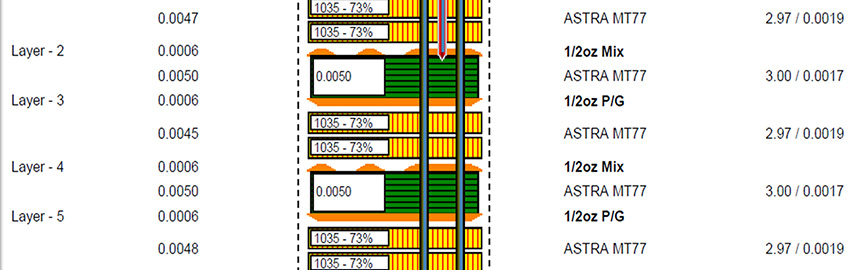
Reviewing the stackup is the second step. The stackup is the difference between a highly efficient design with low noise and EMC compliance versus a poorly designed board. An effective stackup relies on certain factors. First is specific board thickness; it cannot be any less or more than the specified maximum thickness. For example, a compact PCI card calls for maximum board thickness of 0.062" because of connector constraints.
The second is the minimum number of layers required for routing; that is typically governed by FPGA depth. The third factor is the impedance requirement on the layout. The thickness requirement can be like the typical 50Ω, 65Ω for PCI and 100Ω for differential signals, as well as sometimes 75Ω for video outputs. The most typical are 50Ω and 100Ω. Basically, 100Ω differential is equivalent to 50Ω single-ended.
Power and ground plane requirements are the next factor to consider. It’s known that a reference plane is required for impedance control signals. An ample amount of ground planes meet these particular signals, and they should be unbroken with no voids or splits. The next factor is the number of power planes that depend on the power requirements of the board.
Then, the PCB layout engineer determines if there is a planar capacitance requirement. In recent times, greater numbers of designs require planar capacitance, which is capacitance between the power and ground planes (Figure 2). Here, power and ground planes are stacked next to each other with an extremely small dielectric between them, for instance 0.003" to 0.005". This provides a blazingly fast switching planar capacitance on the board, and it reduces the requirement for many decoupling capacitors on that particular board.
The type of board material is the last, but not the least, factor associated with stackup. Materials such as FR-4 and its equivalents can be used for up to 5GHz with little or no problems. Higher rise times call for the use of the more exotic materials like Nelco’s and Rogers’. The reason: They have a low dielectric constant (Dk) value, which provides for faster signaling and low dielectric losses. However, there are cases where OEMs specify FR-4 at even higher speeds. A major recommendation in this regard is for those OEMs to add filtering to the signals to compensate for the Dk inconsistencies that FR-4 produces.
The actual weave of the material also requires special attention. Weaves come in different types: For example, version 106 is tailored for extremely low speed, while 1080 is an exotic material designed for extremely high speed. The difference is that the high-density 1080 glass weave provides for more constant, uniform dielectric all over the board. It is highly desirable to maintain this uniform dielectric, especially for high-speed signals. Without a uniform dielectric, skews are created. But there are compromises between these two material weaves, such as a medium woven glass style like 2116. It is not very exotic or overly expensive, but acceptable for high-speed signals.
The factors described above are the ones affecting stackup. Once the stackup is created, it is sent to the printed circuit board fabricator, which verifies it has all necessary materials in-house. At the same time, the layout designer works with the fabricator to work up the trace geometry details based on the impedance requirements on the board.
The Layout
Layout continues once the necessary data come from the fabricator. At this point, take a close look at the skin effect associated with extremely high-speed traces. The higher the speed, the more skin effect there is. To counter this problem, gold plating is used on the high-speed traces and pads, which needs to be specified on the fab drawing.
Laying out the power supplies is the first step. A good idea is to identify all the power supplies on the board, create small blocks of power supplies, and precisely follow manufacturer’s guidelines and switchers’ datasheets. Switchers are extremely noisy, and most of the noise on the board is due to the power supplies; hence, they should be dealt with first. Power supplies switching nodes need to have very low inductance. Also, feedback traces on the power supplies should be very clean and placed away from these switching nodes.
Once the power supply layout is completed, then the isolation of analog and digital signal starts. That is done during placement as well as routing, so it is an ongoing process during the entire layout phase. At this juncture, digital-to-analog converters (DACs), analog-to-digital converters (ADCs), clock circuitry, and FPGAs are placed, and the power supplies should be isolated by placing them on one of the edges or corners.
Think about the traces not just in terms of routing, but also visualize the returns. While returns are not yet specified as signals, visualize they are going through the ground planes as returns. When a ground plane is created, it must be split between separate analog and digital sections.
Power planes are the next consideration. Isolation between analog and digital power rails and between digital ground and analog ground is recommended. If any of the digital power or ground overlaps with the analog power or ground, it will cause capacitive coupling, which can cause digital noise to be transferred into analog traces. Figure 2 shows how an overlap between digital and analog planes can induce noise.
Proper placement of decoupling capacitors is a next step to ensure signal integrity. They must be placed near the IC power and ground pins and connected to a very low inductance trace, both with the pin and to the ground plane through a via. By doing this, ground bounce and VCC sag are avoided during switching. During switching, current can flow through ground traces, hence the need to have a low inductance to the power and ground plane. Also, it helps considerably when planar capacitance is added.
Still another key consideration is proper decoupling capacitors for BGAs. It is recommended that decoupling caps be placed right on the opposite side of the BGA right below the pin itself (Figure 3). Therefore, BGAs will be fanned out with a via that is on the pad. It’s filled either with a conductive or nonconductive filling. Some manufacturers recommend the use of a nonconductive filling because it provides a surface that is more flat after the plating. Vias are placed shut and have a flat finish on the topside. At the opposite side of the BGA, on the bottom side, are the decoupling caps. This provides a low inductance path from the BGA to the power system.
If an FPGA is used in this high-speed design, I/O optimization is necessary before routing is started. This option can be considered either in the layout or in the schematic, and is performed to optimize those signals, because most of those data pins are pin swappable. The schematic designer can switch those I/Os, and once the net list is re-imported, a cleaner view of the rat’s nest can be achieved. Consequently, routing becomes simpler and clean once those signals are routed.
Syed W. Ali, C.I.D+, is a PCB layout engineer at Nexlogic Technologies (www.nexlogic.com); This email address is being protected from spambots. You need JavaScript enabled to view it..