Kent Balius is vice president, global front end engineering, and Stephan Hackl is CAM lead at Viasystems (viasystems.com). Julian Coates is director of business development, Valor Division, Mentor Graphics (mentor.com).
A March earthquake. September floods. Social unrest. Throughout 2011, upheaval was in the air.
Acquisitions, bankruptcies and Mother Nature were the name of the game in 2011, as topsy-turvy market conditions coupled with inexplicable environmental disasters and unprecedented social backlash led to what were in some cases previously inconceivable opportunities.
In what will remain a year for the books, an earthquake and subsequent tsunami hit northeastern Japan, wiping out scores of manufacturing plants and other business, and leaving painful images of the dead. But in what turned out to be Japan’s finest hour, the nation recovered quickly, with most multinational business back to normal within two quarters. Thailand wasn’t so fortunate. Plants there took such a drubbing that it could be a year before they are usable again. Worse, the repeat disasters had decision-makers rethinking their supply-chain plans.
Had it not been for the weather, the story of the year would have been Elcoteq. Once a top 5 EMS company, the onetime main supplier to Nokia found the competition from Foxconn too much to overcome. It saw sales and profits spiral down over a five-year span, then finally declared bankruptcy last fall, shuttering or selling all but four of its 13 manufacturing sites.
Watching, and perhaps learning from, Elcoteq’s mistakes, No. 2 Flextronics bailed from the price-sensitive PC assembly space in 2011. Having just formally entered the PC production business in 2008, Flextronics quickly grew that segment to $4 billion in annual revenue, only to see margin erosion threaten to wipe out the company’s profits. Competing in a commodity space works only for the largest player, it seems.
Speaking of the largest player, Foxconn (who else?) in 2011 continued its long reign at the top of the pile. It seems hard to imagine, but 10 years ago, Foxconn trailed Flextronics, Solectron, Sanmina-SCI and Celestica in annual revenues. Still, cracks in its formidable armor began to show. Dinged by government-mandated wage hikes, Foxconn has moved much of its reportedly 800,000-man workforce inland, leaving its Shenzhen campus to Apple (more on that in a moment). Worldwide social pressures shone an uncomfortable spotlight on Foxconn, where a blitzkrieg of worker suicides, plant explosions, inflammatory statements (and, perhaps, just a little bit of Apple fatigue) put the firm squarely in the crosshairs of the mainstream media, not to mention several workers’ rights NGOs. In response, Foxconn intimated plans to automate a number of its operations with robots.
Upheaval. An army of robots would have made no difference in Thailand, which was turned upside down when fall floods like none seen in the country in 50 years soaked the nation for the better part of two months. No EMS company was decimated more than Fabrinet, No. 19 on the 2010 list and headed for an even higher ranking. High waters breached two of its facilities, rendering one permanently closed and taking the other offline for months. Others that felt the impact in Thailand included No. 6 Cal-Comp, No. 7 Benchmark, No. 42 Hana Microelectronics and No. 47 SVI Public Co.
No. 14 Beyonics also was hit hard by the Thailand floods. Having seen sales fall about 15% over the past two years, and in the midst of five straight unprofitable quarters, the Singapore-based firm in October announced plans to go private. (The company should know something about going private; its founders came from Flextronics, which did the same thing in 1987 before relisting in 1991.)
[Ed.: To see Table 2, the list of the Top 50 EMS companies, click here. To enlarge the table, right-click on it, then click View Image, then left-click on the table.)
In the aftermath of Japan and Thailand, certain OEMs and EMS companies are rethinking their supply chains. No. 3 Jabil already has made clear it wants to navigate away from the all-in-one industrial parks – where suppliers sit almost on top of each other – so characteristic of the Pacific Rim. Moreover, as companies become more aware of time-to-market and the amounts of capital tied up in product in transit from distant lands, a trend is emerging toward positioning production closer to the point of end-use, a phenomenon known in the US as “reshoring.” Social pressures, accented by the long and loud protests over alleged worker exploitation that have landed Foxconn (and its leading customer, Apple) on the front page of The Wall Street Journal for all the wrong reasons, are also leading assemblers to contemplate not just higher but politically safer ground.
As usual, major mergers and acquisitions changed the face of the CIRCUITS ASSEMBLY Top 50 list. No. 21 OnCore Manufacturing, a major defense and aerospace supplier, acquired Victron in what was essentially a merger of financial equals. No. 31 Ducommun made the biggest splash in its 157-year history, acquiring LaBarge in June to form a defense electronics powerhouse. No. 16 AsteelFlash bought Catalyst EMS. (Just after the year ended, No. 8 Plexus announced a deal to acquire Kontron Design Manufacturing Services in Penang.)
Falling off the list was EPIQ, which sold a total of five plants in Bulgaria, Czech Republic and Mexico to No. 25 Integrated Microelectronics Inc. Also departing was Surface Mount Technology Holdings (No. 45 in 2010), the Hong Kong-based EMS firm that endured a painful reorganization in 2011. Revenue plunged 38% year-over-year to about $177.6 million. Suffering a similar fate is former Top 50 mainstay Simclar, which has seen sales fall from a high of $400 million in 2006. Joining the list were several large flex circuit companies whose EMS revenues were previously not properly accounted for. Most flex PCB fabricators also perform assembly, and it is difficult to get an accurate reading of the value of the bare board from the finished assembly. However, based on data from IPC and others, bare flex circuits comprise roughly 40% of the shipment value. Based on such estimates, No. 12 Nippon Mektron (which has at least 11 plants that perform SMT assembly) and No. 28 MFLEX are now represented in the Top 50.
Whither Kaifa? Not making the list: Sichuan Changhong Electric, a huge Chinese entity (35,000 employees) that makes TVs, white goods and other components. While it builds product for several brand name Japanese OEMs, it was impossible to determine just what its EMS/ODM sales were in 2011. Same goes for Aeroflex. We also left off ODMs such as Qisda, Compal, Wistron, BenQ, and others that are essentially OEMs.
Should Shenzhen Kaifa Technology be included in EMS rankings? It’s not an easy question to answer. On revenue alone, perhaps: Kaifa, as the company is known, had sales of over $4 billion last year. Using that gross number would place it squarely between Sanmina-SCI and Cal-Comp in the Top 10.
But there’s more to it than that. Kaifa generates an extraordinary amount of its revenue from making and selling hard disk drives to Seagate. In fact, under most classifications, Kaifa would rank as an ODM, and not just of printed circuit board assemblies.
Then there’s the confusion of what, exactly, “Kaifa” is. The company, which is supposedly traded under the ticker symbol 00021 on the Shenzhen Exchange, has no current listing. However, it is also apparently a subsidiary of China Electronics Corp.
CEC is giant. The conglomerate says its annual revenues topped $8 billion back in 2006, and it employs more than 70,000 workers across some 61 subsidiaries, including 13 listed holding companies. Among them are cellphone and datacom OEM Panda Electronics, computer and TV manufacturer Greatwall Technology, and yes, Kaifa.
It also is state-owned, and operates directly under the administration of China’s central government. Forget, for the moment, how strange it is for what is essentially a government entity to be publicly traded. Consider instead whether a government business can be considered a contract manufacturer, especially in China, where the Communist Party still holds sway over most economic policy and can pick the winners and losers at the drop of a hat. Want to get a government contract? Use a government provider. It becomes hard to distinguish between what is competitive bidding and what is political.
Then there’s the matter of CEC’s financials. They are dense, to be sure. It’s hard to tell what revenue comes from external customers and what is just “padding” from its own pyramid. Among those that can be discerned, Greatwall alone made up $1.6 billion in revenue in 2010. Read the fine print and you’ll see the company has several “deals” in place to buy components and services from other CEC subsidiaries.
So should Kaifa be listed on the CIRCUITS ASSEMBLY Top 50? Because it is next to impossible to know what its true revenue from EMS-related activities is, we say no, while respecting the decision of others to disagree.
EMS is a lopsided business. The CIRCUITS ASSEMBLY Top 50 make up about 87% of the total revenues of the entire electronics outsourcing industry, although that figure admittedly includes a fair percentage of revenue that would properly be classified as ODM work. The industry as a whole reached about $205 billion in sales last year, according to IHS iSuppli.1 (The research firm predicts industry revenue to be flat in 2012.)
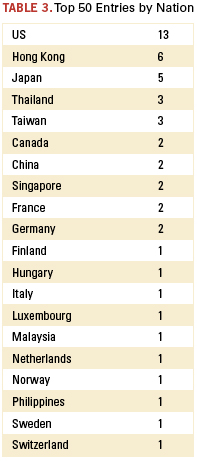
The US continues to dominate the Top 10 list, with five of the top eight entries, although we are seeing some minor shifts take place (Table 3). Regionally, the Top 50 remain intact, led by Southeast Asia (16 entries), North America (15) and Europe (12). Japan gained two entries, a reflection of heretofore unacknowledged EMS work. Notable for its lack of entries is Russia, which almost certainly has domestic firms that would qualify, and whose electronics assembly industry was forecast to reach $14 billion in 2010 (55% of which was industrial or military).2 While changes in the rankings have been most common in the middle to lower half of the list, a few firms are threatening to shake up the top. Given their organic growth and acquisition strategy, respectively, Zollner and AsteelFlash look like good bets to break into the Top 10, should any of the current leaders falter.
References
1. Mike Buetow, "iSuppli: EMS in for Flat Year," circuitsassembly.com, Feb. 7, 2012.
2. Ivan Pokrovsky, "Electronics Manufacturing in Russia," New Russian Electronics, Business Industry Yearbook, 2008.
After a week in San Diego, Las Vegas seemed a strange old world.
A new location, a new lease on life.
Three tepid years in Las Vegas left many observers wondering if, when it came to the IPC Apex Expo trade show, Elvis had left the building.
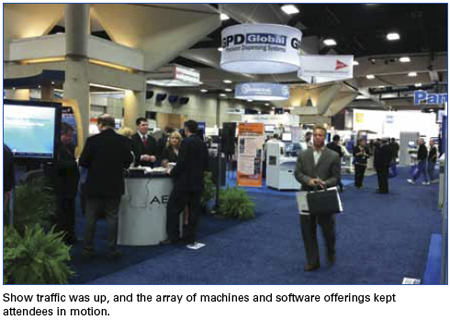
But the move to the San Diego Convention Center was a revelation. It was as if all it took was a little sunshine (and a few fewer slot machines) to breathe new life into the doddering show.
From the opening bell, attendees swarmed keynote speaker William Shatner, some sporting Trekkie gear and other paraphernalia as they lined up by the hundreds to get photos and autographs from the famed Star Trek actor.
On the show floor, the vibe carried over, with attendance and attitudes perked up. Was it the improving economy, a different mix of attendees, or the new site? Hard to say, but exhibitors weren’t complaining.
Attendance seemed strongest the first day, and the momentum carried over through the middle of the second day. Things slowed a bit that afternoon, but picked up at the show-floor reception. Day 3, as usual, crawled.
We noticed the show itself was not as well organized as in the past. Previous shows grouped fabrication suppliers more or less in one place and assembly suppliers in another. That all changed this year. While industries (fabrication, assembly) were delineated (sort of) by the color of carpet in the various exhibitors’ booths, there was a nearly random nature that made trying to visit all the suppliers of a certain product inconvenient. Having the show split across two floors didn’t help either. Most of the products shown at Apex Expo were introduced at Productronica and have already been covered by this magazine both in print and online; we will focus here only on new releases, with a couple exceptions as noted.
The most interesting developments included a new inline printed circuit board assembly cleaner from Aqueous Technologies. Named Typhoon, the short (12' linear length) machine is considered safer than many traditional models, thanks to magnetically conductive pumps that permit it to run (at reduced cleaning performance, of course) up to 36 hr. without water, whereas most models’ pumps freeze up after a few minutes under such conditions. The machine features rotating air knives, a 24" wide conveyor, and zero or filter discharge.
Speaking of cleaning, we also viewed our first full demo of Speedline’s new Aquastorm batch cleaner. Speedline’s engineers came up with the novel idea of firing water at the board straight from the rack’s spindles, providing ample power, always the bane of batch systems.
Two companies (SMT and A-Tec) are now supplying inline convection reflow ovens containing vacuums, which are said to help reduce voiding. Matt Holzmann at Christopher Associates proudly displayed the MEK S1 SPI, reportedly with 50µm resolution and 5D vision, claimed to be the fastest SPI on the market.
At Juki, the biggest news came just ahead of the show opening, when the placement company inked a deal to distribute JT’s reflow soldering equipment in the Americas. Now armed with a printer (courtesy of January’s deal with GKG), and a complete line of soldering machines, Juki seems armed to do battle in the full-line fight. (Heller, with which Juki had previously teamed on an informal basis, seems the odd man out.) CEO Bob Black also privately showed a startling development that, while we cannot yet reveal, is likely to shake up the process equipment market down the road.
Yamaha made for an interesting presence, with a large booth and several machines, not all of which were for placement. The company, which is slowly separating from its longtime Americas distributor Assembléon, also had an AXI machine on display. (Assembléon, we should note, did pick up an NPI Award for its new iFlex placement platform, debuted at Productronica, as well as a Service Excellence Award – its tenth in a row.)
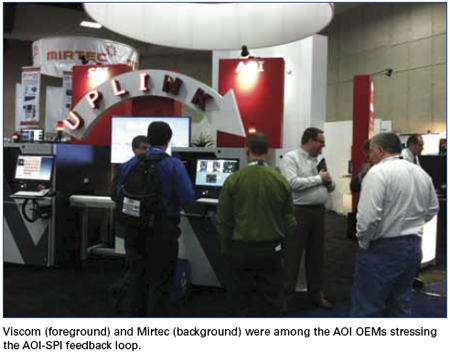
Several AOI OEMs, Koh Young, Mirtec, CyberOptics and Viscom among them, are doing a much improved job of tying SPI and post-reflow inspection data to the screen printer. The efforts in this area to make the data captured during inspection meaningful for in-process production were noticeable.
Fears of a lingering slowdown seemed overstated: Soldering oven manufacturers such as BTU and Speedline Technologies, as well as CyberOptics and BPM Microsystems, indicated strong demand, especially since January. Automotive seems to be driving much of the recovery. BTU is planning an expansion at its Shanghai-based campus.
Aegis Industrial Software has a slick new tool called inForce, a touchscreen and I/O unit that monitors and controls boards as they proceed down the conveyor, and feeds the data back to the Aegis MES factory software, aiding traceability.
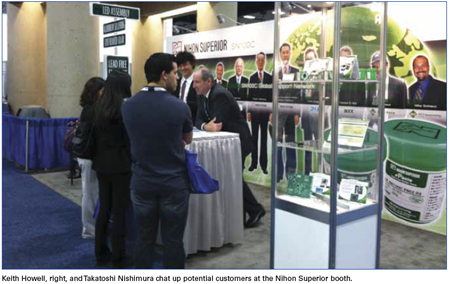
We spent considerable time with the materials vendors. AIM noted sales were up 41% year-over-year in 2011, while Cookson saw sales at its Alpha unit rise about 18%. (Raw metals price inflation contributed strongly to the increases.) AIM will open a plant in Poland for blending powder, liquid flux and bar solder, and plans to expand its Montreal and Juarez operations as well. Henkel rolled out four products, including underfill brands for jetting (seeing more of that, too) and traditional dispensing. Many materials companies noted the huge potential in the LED market, although one suggested some lower-energy, higher-brightness alternatives such as ITO should not be ruled out.
There’s some disagreement as to how much the conversation over low-silver solders will translate into actual use, however. Some vendors said that low-silver is starting to transition from the discussion phase into actual production. However, other vendors say it’s mostly hype, adding that the cost-savings tradeoff versus the amount of process development work that needs to go into characterizing each alloy makes change questionable at best. We also are hearing SAC 305 is losing popularity. An iNEMI project team led by Dr. Greg Henshall of HP is evaluating 16 different alternate solder materials; it could be that once that group has completed its work, the picture will become clearer for users.
The EMS companies exhibiting, including STI Electronics and Divsys, were generally bullish in 2012, saying most of the pain from military spending delays should be worked through by the second quarter.
Apex Expo is a misnomer: The “Expo” part is a throwback to when the show was aimed at board fabricators. Those days went the way of Gene Roddenberry. Finding fabrication equipment on the show floor is unusual, and vendors said new sales are going to replace old machines, not to add capacity. Dow, Oak-Mitsui, RBP Chemical, Ventec, Park Electrochemical and Rogers were among the materials companies with new or soon-to-be released products. Isola revealed it completed the beta testing and internal qualification for I-Speed, a Pb-free compatible, low-loss, high-speed digital laminate. The company has also teamed with Circuit Foil on Ultrathin, a 40µm glass-reinforced laminate said to eliminate the thermo-mechanical mismatch issues commonly associated with unreinforced films. The Tg tops 170⁰C, and Young’s modulus and CTE are said to be similar to high-Tg systems.
LPKF has a new, versatile UV laser (Protolaser U3) said to be for depaneling, drilling, marking and surface etching on FR-4, ceramic or other high-frequency RF substrates. PCB cleaning equipment OEM Teknek will double its headcount in Asia and has added a small number of staff in Germany as well.
We had a nice long talk (for the show) with iNEMI president Bill Bader, who provided a rundown on the consortium’s programs – and there are a lot of them. iNEMI officially launched three new projects in medical in January, with three more in “definition.” UL Research is leading a project to update its standards and specifications methodology. Also, a white paper on harmonization of environmental data management is underway.
On the move. At Universal Instruments, George Westby has semi-retired from the UIC Consortium, and Dave Vicara has been named to run the lab. Also, Jeff Mogensen, last seen with Speedline, has joined Parmi, and his former colleague Greg Lefevbre has joined Cardinal Circuit. And another Speedline alum, Shean Dalton, has launched his own rep firm.
Brian O’Leary, formerly of KIC, has joined Trans-Tec (Yamaha’s distributor in the Americas) as general manager, and Lino D’Andretti has joined him in sales. Seho appointed Alexander Riedel director of customer service, and Europlacer named Chris Round global marketing manager. Rogers named Jeffrey Grudzien vice president of its Advanced Circuit Materials division, replacing Michael Bessette, who is retiring after 37 years with the company.
IPC has narrowed its search for a new president to three candidates, none of whom is reportedly from the IPC staff. All have association backgrounds, but some are said to have various degrees of indirect industry experience. A decision is expected in the next few weeks. (Ed: Update: http://www.circuitsassembly.com/cms/news/12678-ipc-names-mitchell-president-and-ceo)
Longtime MacDermid engineer Denny Fritz was inducted to the IPC Hall of Fame, and Dr. William Coleman of PhotoStencil and Mike Bixenman of Kyzen received the President’s Award for their contributions to the organization.
Overheard. Spokesmen from Nordson Dage and OK International acknowledged their respective companies are seeking acquisitions in the coming quarters.
A bid has been made for a major ($500 million-plus) publicly traded US-based EMS company, but so far the company’s asking price is higher than market value.
There was some chatter that the US Department of Defense is considering lifting the ITAR ban on PCBs, which would dramatically shake up (read: eviscerate) the US PCB market. TTM, the largest PCB supplier to the Pentagon, and others are said to be pushing back on the DoD.
All in all, a good week. The show remains in San Diego next year, then back to Las Vegas. So much for boldly going where no one has gone before.
In San Diego last month, CIRCUITS ASSEMBLY revealed the winners of its 20th annual Service Excellence Awards at IPC Apex Expo. Electronics manufacturing services providers and electronics assembly equipment, materials and software suppliers were recognized for top-notch customer service. Each firm’s own customers rated them in an online survey process during the months leading up to the trade show.
EMS winners with the highest overall ratings included EPIC Technologies in the large company category (revenues between $101 million and $500 million), Applied Technical Services in the medium company category (revenues between $20 million and $100 million), and Burton Industries in the small company category (revenues under $20 million).
EMS companies with the highest scores in each of five individual service categories were honored as well. (Overall winners were excluded from winning individual categories.) In the large company category, last year’s overall winner Mack Technologies swept all five individual awards (dependability/timely delivery, manufacturing quality, value for the price, responsiveness, and technology).
Electronics Systems took first place in dependability and value, and tied ACD for responsiveness in the medium company category. ACD also scored the technology award. Western Electronics took home the quality top prize.
In the small company category, Spectrum Assembly took top honors for dependability and responsiveness, and tied Accu-Sembly for first place in quality. Accu-Sembly also won for technology and value.
Electronics assembly equipment award winners were Assembléon America for pick-and-place; DEK International for screen printing; Kyzen Corp. for cleaning/processing materials; Nordson YesTech for test and inspection; Nordson EFD for materials; Nordson Asymtek for dispensing, and KIC for soldering equipment. Aegis Industrial Software received top honors in the automation/manufacturing software category.
CIRCUITS ASSEMBLY and PCD&F also announced the winners of the 2012 New Product Introduction Award for electronics assembly equipment, materials, software, and PCB fabrication at the same event, held on the show floor.
The NPI Award, in its fifth year, recognizes leading new products during the past 12 months. An independent panel of practicing industry engineers selected the recipients.
The winners included Cognex in the process control tools category for the DataMan 500 and Speedprint in the screen/stencil printing equipment category for Speedprint SP700avi. Seika Machinery won the screen/stencil printing peripherals prize for the Sawa Ultrasonic Stencil Cleaner SC-AH100F-LV Low-VOC Model. Aqueous Technologies was honored for cleaning equipment with its Trident XLD, while Data I/O took home an award for device programming with its RoadRunner 3 with FIS.
For dispensing equipment, GPD Global took top honors for PCD Dispensing on MAX series platform. CyberOptics scored the number one spot for AOI test & inspection with the QX100. ICT test & inspection went to Datest for the SPEA 4060 Flying Probe Tester with Goepel Boundary Scan. Test & inspection – functional test was awarded to Agilent Technologies for TS-8900. ViTrox Technologies won for its V810 In-Line 3D AXI in the AXI test & inspection category.
AIM was honored for soldering materials with NC259 solder paste, and LPKF Laser & Electronics was awarded for its LPKF MicroLine 1120 P in the automation tools category. Multifunction component placement went to Assembléon America for iFlex, and Juki snagged the award for high-speed component placement for its Sentry tool. Speedline Technologies’ Closed Loop Nitrogen Control was honored for reflow soldering, and Seho Systems’ AOI system to be embedded in a selective soldering machine was recognized for selective soldering.
Kyzen’s Aquanox A4638 took top prize for cleaning materials, and Cogiscan’s LabelScan Automated Vision System was number one in labeling equipment.
Juki’s second award was for production software for its Juki IS NPI+ Bundle. Microscan was awarded in the process control software category for its AutoVISION machine vision software.
In the soldering – other category, EVS was given a plaque for its EVS 7000LFHS solder recovery system redesign. Nihon Superior was honored in the cored wire category for (SN100C (551CT)) lead-free flux-cored solder wire, while Semblant won for its SPF (Semblant Plasma Finish) in the coatings/encapsulants category.
Christopher Associates took home a plaque for the Magnus HD Trend in the rework & repair tools category, and KIC was honored in wave soldering for its KIC 24/7 Wave.
Finally, for surface treatment, Dow Electronic Materials won for its Circuposit Hole Prep 4126 Sweller.
Congratulations to all of 2012’s honorees. Join us again next year, when IPC Apex Expo returns to San Diego, where we’ll recognize a new batch of industry standouts during our 2013 event. Check back to circuitsassembly.com and pcdandf.com for more details soon.
A 30-year-old idea is coming in vogue, with stunning implications for design engineering.
“3D printing is going to play an increasing role in the future of electronics,” says David ten Have. “I’m not predicting an immediate revolution, but printed electronics will start to fill various niche applications, and that’s going to lead to some ground-breaking technologies.”
Ten Have is CEO and cofounder of Ponoko, the company behind Personal Factory, a web-based platform for the creation of custom goods. Ponoko users can make their own products using a variety of digital manufacturing methods, including laser-cutting, CNC routing, and 3D printing. More than 100,000 consumer-designed products have been made, and demand for 3D printing is on the rise.
3D printing is an additive manufacturing technique that translates digital models into physical objects by building up layers of material. A number of competing 3D printing technologies variously use chemical-, heat- or light-based methods to fuse material together layer-by-layer. Resolution depends on the printer type, but some of the more advanced machines can achieve a resolution in the micron range. For instance, the Objet Connex desktop printer has a minimum layer thickness of 16µm.
While many of these technologies have been in use since the 1980s, 3D printing has become much more accessible in recent years as a result of increased functionality and decreased cost. Companies like Ponoko, Sculpteo and Shapeways have emerged to provide online 3D printing services. Open source hardware projects like the MakerBot, RepRap, and Fab@Home have brought 3D printing technology within reach of the home hobbyist, with kit sets available for under $1,000. These machines in particular have been enthusiastically embraced by the DIY electronics communities.
There are two distinct advantages of using 3D printing over traditional manufacturing that could lead to some dramatic changes in many areas of industry: The first is it undermines economies of scale; it is now possible to make one-off objects that would otherwise have required mass-production. The implications both for prototyping and customization are profound. The second advantage is it makes it possible to produce objects that could not be made in any other way, as a result of complexity or internal features. Complex assemblies of moving parts can be designed to come out of the machine preassembled.
3D printing circuit boards. PCB production is an application for 3D printing being pursued both by industry and hobbyists. Developments are primarily focused on material research at present. 3D printing has been demonstrated with many different kinds of metals, plastics, ceramics, polymers and organic materials. With the right combination of materials, modern multi-material printers would have no trouble printing PCBs. Being able to produce high-quality, multilayered one-off boards would be a huge advantage for design engineers and home hobbyists alike, greatly simplifying the prototyping cycle and removing the time and material expense of masking and etching.
Hobbyist-led advancements. In the hobbyist realm, early signs of development in this area came in 2009 when Bath University mechanical engineering student Rhys Jones revived the old idea of making PCBs by depositing metal into pre-formed channels. He modified his RepRap 3D printer to extrude molten solder into a pre-printed ABS plastic substrate. While the melting point of solder is higher than that of ABS, the specific heat of the metal is so low that the plastic doesn’t melt. After manual assembly, the completed circuit was then installed on the actual machine that printed it. This was an early milestone for the RepRap project, whose stated aim is to create self-replicating machines.
While this process is still in its infancy, it could soon prove to be popular with home 3D printing enthusiasts that want basic custom circuit boards, without dealing with the hit-or-miss home PCB etching process. Another bonus to 3D printed circuit boards is the integration of mechanical features. For example, it would be elementary to include mounting clips in the design.
Another open source project, Fab@Home, has demonstrated the use of conductive and non-conductive silicone to print flexible objects with internally embedded circuitry laid out in three dimensions.
The rise of DIY electronics. Hobbyist 3D printing and DIY electronics are two major forces democratizing technology, and their development is entwined. In 2005, the launch of yet another open source project, the Arduino, marked a turning point in the world of hobby electronics. Arduino rapidly gained a reputation as the first truly user-friendly microcontroller development platform.
This platform opened up the world of embedded computing to a much larger audience, and it remains popular among artists, educators, and hobbyists, with an ever-increasing number of extension modules (e.g., sensors, driver boards, communication interfaces, etc.) available. These modules, known as “shields,” take the form of traditional PCBs that can be plugged into the Arduino board with stacking headers.
3D printing creates the possibility for these modules to take any shape, a feature that could further functionality and user-friendliness of these shields. For instance, one can imagine a modular robotics system with an Arduino processor embedded into a printed “torso,” a camera or rangefinder embedded into a printed “head,” and interchangeable “limbs” containing other sensors and actuators, with all associated electronics integrated seamlessly into each piece.
With the increasing popularity of DIY electronics and 3D printing, it is fair to assume that progress will continue to empower the home hobbyist with ever more capable and user-friendly fabrication techniques. One immediate area of development to look out for is a standardized file-format – a common protocol for defining designs. This will be the precursor to any serious activity in the open source community.
Industry-led advancements. Looking to the industrial realm, Dutch research institute TNO (tno.nl) has pioneered a number of different circuit printing technologies. It recently printed a simple circuit in copper, along with flexible integrated housing, all in one step. This hints at another exciting and disruptive possibility of 3D printing; it allows the designer to do away with the circuit board altogether, integrating the electronics with other functional parts of the product.
As these technologies become established, 3D printed circuits could lead to tearing down several design constraints. For starters, there’s no reason a 3D-printed board would have to be a typical rectilinear planar surface (Figure 1). Disrupting the 2D PCB design paradigm could have some radical implications for design engineering. Traditional flat PCBs force design constraints on the layout of components and inefficiencies on space and material usage, constraints that will disappear when the PCB can take any conceivable shape.
Yet another benefit of using a 3D printer to build circuit boards is that many types of printers share most of their mechanical characteristics with a pick-and-place component assembly machine, meaning an all-in-one PCB printing and assembly unit could be just around the corner.
Beyond simply changing the way we make circuit boards, developments in printing technologies are set to potentially revolutionize the production of all kinds of electronic components. 3D printer manufacturing firm Objet recently mused on its company blog about the likelihood of printing both circuit boards and integrated semiconductor components at a point “not too far in the future.”
Academia-led advancements. Some of the bleeding-edge technologies at the R&D stage today indicate some very exciting developments for printed electronics in the longer term.
Printed solar panels are flexible and significantly lighter and cheaper than their traditional clunky glass-mounted counterparts. Developments in this field over the last few years have substantially reduced the cost, with the Holy Grail being small, disposable power for applications such as smart packaging. Researchers at MIT1 recently demonstrated a highly flexible and robust solar panel printed on paper “almost as cheaply and easily as printing a photo on your inkjet.”
This comes in the wake of Stanford University’s research in the field of nano-material technology, proving it is possible to store energy in super-capacitors made by printing carbon nanotubes onto treated paper.2
The flexibility of printed electronics has the potential to be hugely influential in other applications, especially mobile devices where a printed flexible OLED display could be unfolded to a size larger than a handset. Flexible interactive screens are in the prototype stage, and printed e-ink displays already have been demonstrated playing color video on a paper-thin plastic substrate.
Other recent advancements include printed sensors, transistors, and low-density data storage, meaning entire consumer devices could one day be conceivably printed in one continuous process on a single machine. Aggressive research efforts in industry, academia, and the growing community of sophisticated hobbyists make the field of 3D printed electronics a fascinating and important one to keep an eye on.
References
1. Miles C. Barr, et al, “Direct Monolithic Integration of Organic Photovoltaic Circuits on Unmodified Paper,” Advanced Materials, vol. 23, no. 31, Aug. 16, 2011. 2. Katherine Bourzac, “Print on Demand Power, MIT Technology Review, April 27, 2009.
Richard D. Bartlett is an engineer, artist, writer and practicing futurist based in Aotearoa, New Zealand.
A rundown of electrical and physical considerations.
In my previous columns, I’ve stressed the importance of the partnership between OEMs (or ODMs) and flex manufacturers throughout the product lifecycle, to properly apply flex technology. A good flex design has the right blend of performance, manufacturability, and cost: three factors that ultimately impact the success of a product launch.
This month, I focus on how and when OEMs and flex manufacturers can use material selection to optimize design for performance. Material selection plays a critical part in improving manufacturability and offering performance gains. Material selection begins with a thorough understanding of the application requirements, including the components to be used and the physical constraints for the flex assembly.
Flex design engineers, mechanical engineers and electrical engineers determine the required outline, stackup and layer construction to achieve the necessary connectivity of the flex circuit. To illustrate the different stackup options, Figures 1 to 3 show available choices for a two-layer flex circuit, depending on bending requirements. After engineers determine the stackup and layer construction, the flex manufacturer can start selecting materials to meet the requirements for bending, flexibility, dimensional stability, components, circuit density, impedance characteristics, electrical properties, thermal resistance, tear resistance, low moisture absorption and chemical resistance.
Simulation analysis and empirical knowledge enable correct material selection to achieve optimum mechanical and electrical performance. Simulations also offer fast, thorough insight into the potential conflicts during component assembly. OEM engineering teams should engage with their flex manufacturer/assembler to review simulation data, to make better decisions on the tradeoffs between cost, performance and manufacturability. Different materials available for flex circuits are:
Dielectrics. Dielectrics for flex circuits (compared to glass-reinforced dielectrics for rigid PCBs) are characterized by their thinness, flexibility, mechanical strength, thermal properties, and dielectric properties. The suitable dielectric film depends on operating environment, electrical and mechanical properties, assembly requirements and cost. Polyimide films are typically used for applications requiring high tensile strength and excellent flexibility. Polyester films are used for lower-cost applications. High-performance fluoropolymer films offer superior electrical properties and are considered for low insertion-loss requirements for high-speed applications. The thickness of dielectric materials commonly ranges from 12 to 50µm. Dielectrics can be used as a base laminate and a coverlayer when combined with adhesive.
Conductors. Choosing a conductor material depends largely on the material’s performance during specific applications. In particular, dynamic applications require the right choice of copper type and thickness. Commonly used copper thicknesses are 12µm, 18µm and 35µm. Electrodeposited copper, rolled annealed (RA) copper and high tensile elongation (HTE) copper are commonly used. While the most common solution for dynamic applications is HTE, RA copper is still in wide use. In addition to copper, other conductive materials include copper-nickel alloys and conductive inks.
Solder masks. Liquid photoimageable (LPI) solder masks are solder resist inks applied onto a flex circuit, then cured with a thermal or ultraviolet process. The result is a permanent, durable insulation. The preferred insulation material is coverlayer. In case of small component areas, solder mask may be required for insulation.
EMI shielding. EMI shielding protects against electromagnetic inference. Copper layers provide the best shielding effect, while flexible silver epoxy paste is the next best option. Silver or aluminum film materials 9 and 22µm thick are commonly available shielding solutions for most applications.
Stiffeners. Stiffeners are used to reinforce flex circuits under areas where components are assembled. When selecting a stiffener, consider overall thickness, thermal properties, shielding, adhesion method and cost. Another consideration is the process to singulate the stiffener to the required shape, and the process needed to attach it. Common materials include polyimide, polyester, FR-4, metal and plastic.
Adhesives. Adhesives fall into three groups: thermal set adhesives create permanently bonded laminates; pressure-sensitive adhesives bond stiffeners or mounting hardware to flex, and conductive adhesives connect shielding stiffeners and flex to various structural components inside a device.
For instance, the outlined approach can be used to select the right materials for a flex circuit to meet dynamic bending requirements to exceed 100,000 cycles. Simulation analysis shows HTE copper on 12µm polyimide dielectric adhesiveless laminate with epoxy adhesive coverlayer provides best results. Copper thickness depends on the fabricator’s ability to meet the characteristic impedance and insertion loss requirements. Simulation analysis also shows the impact of solid ground versus hatch ground to meet the impedance requirements. To meet the dynamic bending requirements, shielding film is the preferred option. Shielding film thickness depends on the flex manufacturer’s capabilities. Even though this example is for a consumer electronics product, it can be easily adapted to other products in any other market.
Designing flex circuits is a collaborative process. The above methodology is one approach for flex manufacturers and assemblers to effectively guide designers toward structures and circuit layout using the right materials to optimize design for performance and improve new product time to market by decreasing ESI and NPI times.
Jay Desai is director of marketing at MFLEX (mflex.com); This email address is being protected from spambots. You need JavaScript enabled to view it..